Getting Started
Installation
You can install EoN version 1.92 with pip
pip install EoN
If you have installed a previous version and want to reinstall with the most recent version available through pip (1.92). The easiest way is
pip install EoN --upgrade
If you are using Anaconda, go to the Anaconda command line and use pip install EoN
To install EoN with a later (in development) version You can clone or download the Github version at https://github.com/springer-math/Mathematics-of-Epidemics-on-Networks
Then just move into the main directory and run
python setup.py install
EoN requires numpy, scipy, and matplotlib. If you don’t have them
and you install through pip, these will automatically be added. Some of the
visualization tools provide support for animations, but producing the
animations will require installation of something like ffmpeg.
Current Version
The documentation provided here is for version 1.92.
If you want to see changes from previous versions, please see Changes from v1.0.
Citing
If you use EoN, or publish anything based on it, please cite the Journal of Open Source Software publication
Also, please let me know so that I can use it for performance reviews and grant applications and generally because it makes me happy.
QuickStart Guide
The code here provides an example of creating a Barabasi-Albert network. Then it performs several simulations of an SIR epidemic starting with a fraction rho randomly infected initially. Finally it uses several analytic models to predict the spread of an epidemic in a random network with the given properties.
import networkx as nx
import matplotlib.pyplot as plt
import EoN

N=10**5
G=nx.barabasi_albert_graph(N, 5) #create a barabasi-albert graph

tmax = 20
iterations = 5  #run 5 simulations
tau = 0.1           #transmission rate
gamma = 1.0    #recovery rate
rho = 0.005      #random fraction initially infected

for counter in range(iterations): #run simulations
    t, S, I, R = EoN.fast_SIR(G, tau, gamma, rho=rho, tmax = tmax)
    if counter == 0:
        plt.plot(t, I, color = 'k', alpha=0.3, label='Simulation')
    plt.plot(t, I, color = 'k', alpha=0.3)

#Now compare with ODE predictions.  Read in the degree distribution of G
#and use rho to initialize the various model equations.
#There are versions of these functions that allow you to specify the
#initial conditions rather than starting from a graph.

#we expect a homogeneous model to perform poorly because the degree
#distribution is very heterogeneous
t, S, I, R = EoN.SIR_homogeneous_pairwise_from_graph(G, tau, gamma, rho=rho, tmax = tmax)
plt.plot(t, I, '-.', label = 'Homogeneous pairwise', linewidth = 5)

#meanfield models will generally overestimate SIR growth because they
#treat partnerships as constantly changing.
t, S, I, R = EoN.SIR_heterogeneous_meanfield_from_graph(G, tau, gamma, rho=rho, tmax=tmax)
plt.plot(t, I, ':', label = 'Heterogeneous meanfield', linewidth = 5)

#The EBCM model does not account for degree correlations or clustering
t, S, I, R = EoN.EBCM_from_graph(G, tau, gamma, rho=rho, tmax = tmax)
plt.plot(t, I, '--', label = 'EBCM approximation', linewidth = 5)

#the preferential mixing model captures degree correlations.
t, S, I, R = EoN.EBCM_pref_mix_from_graph(G, tau, gamma, rho=rho, tmax=tmax)
plt.plot(t, I, label = 'Pref mix EBCM', linewidth=5, dashes=[4, 2, 1, 2, 1, 2])

plt.xlabel('$t$')
plt.ylabel('Number infected')

plt.legend()
plt.savefig('SIR_BA_model_vs_sim.png')
This produces
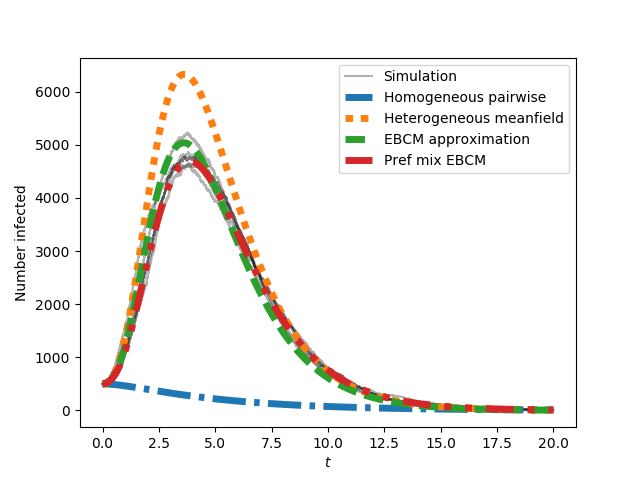
The preferential mixing version of the EBCM approach provides the best approximation to the (gray) simulated epidemics. We now move on to SIS epidemics:
plt.clf()

#Now run for SIS.   Simulation is much slower so need smaller network
N=10**4
G=nx.barabasi_albert_graph(N, 5) #create a barabasi-albert graph
for counter in range(iterations):
    t, S, I = EoN.fast_SIS(G, tau, gamma, rho=rho, tmax = tmax)
    if counter == 0:
        plt.plot(t, I, color = 'k', alpha=0.3, label='Simulation')
    plt.plot(t, I, color = 'k', alpha=0.3)

#Now compare with ODE predictions.  Read in the degree distribution of G
#and use rho to initialize the various model equations.
#There are versions of these functions that allow you to specify the
#initial conditions rather than starting from a graph.

#we expect a homogeneous model to perform poorly because the degree
#distribution is very heterogeneous
t, S, I = EoN.SIS_homogeneous_pairwise_from_graph(G, tau, gamma, rho=rho, tmax = tmax)
plt.plot(t, I, '-.', label = 'Homogeneous pairwise', linewidth = 5)

t, S, I = EoN.SIS_heterogeneous_meanfield_from_graph(G, tau, gamma, rho=rho, tmax=tmax)
plt.plot(t, I, ':', label = 'Heterogeneous meanfield', linewidth = 5)

t, S, I = EoN.SIS_compact_pairwise_from_graph(G, tau, gamma, rho=rho, tmax=tmax)
plt.plot(t, I, '--', label = 'Compact pairwise', linewidth = 5)

plt.xlabel('$t$')
plt.ylabel('Number infected')
plt.legend()
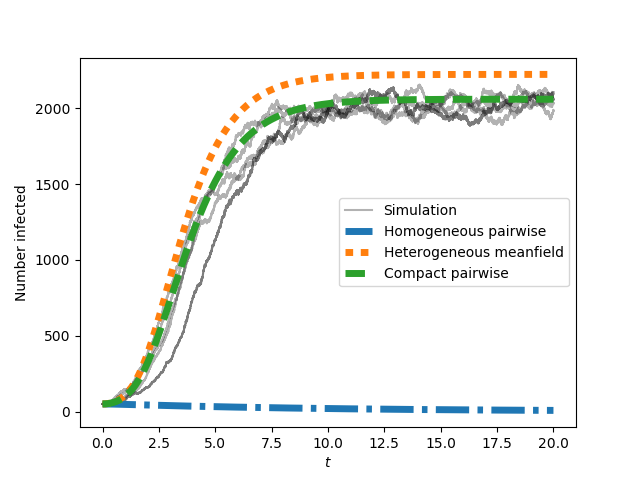
plt.savefig('SIS_BA_model_vs_sim.png')
This produces